

Government Subsidies & FAME Benefits: What You Save Buying an RVX Today
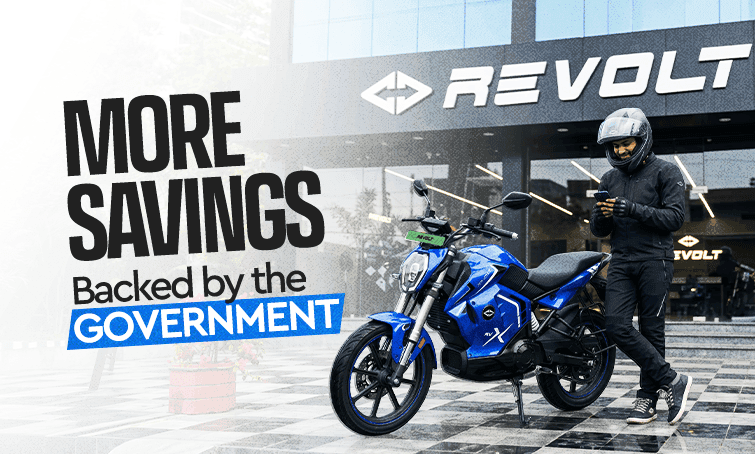
Government subsidies on electric vehicles change often enough that most buyers give up trying to track them, and end up leaving real money on the table as a result. Here's a clear, current breakdown of what's actually available on theRevolt RVX, and how it affects what you actually pay. India's push toward electric mobility isn't just an environmental initiative, it's a deliberate economic one, aimed at reducing fuel import dependency and cutting urban pollution. Both the central government and several state governments offer direct incentives to makeelectric motorcycles more affordable, which is exactly why understanding these schemes matters before you finalize a purchase. For a buyer, these incentives translate directly into a lower effective price, but only if you know they exist and confirm your eligibility before signing paperwork. At the national level, thePM E-DRIVE scheme is the current framework supporting electric two-wheeler adoption, having succeeded the earlier FAME programs. We've covered thespecific subsidy claim process in detail separately, it's worth reading if you're actively planning a purchase, since claim windows and documentation requirements can shift. Central schemes like this typically apply a direct benefit either at the point of sale or through a structured reimbursement process, depending on how the scheme is administered at the time of your purchase. FAME, Faster Adoption and Manufacturing of Electric Vehicles, was the scheme that first established India's EV incentive framework, and its legacy still shapes how current subsidies are structured and administered. If you're comparing older articles or dealership paperwork that references FAME specifically, it's helpful to understand that as the historical foundation for the incentives active today, even as the specific program names and structures have evolved. Beyond the central scheme, many state governments run their own additional EV incentive programs, road tax waivers, registration fee exemptions, or direct purchase subsidies. These vary significantly by state, and in several cases can meaningfully reduce your on-road price beyond what the central scheme alone offers. Before finalizing your purchase, it's worth checking with your local Revolt dealership specifically about what's currently active in your state, since these programs are updated more frequently than national policy, and eligibility windows can open or close with relatively little public notice. The RVX's ex-showroom price is1,24,990 rupees. Depending on which state incentives apply to you and current central scheme eligibility, your effective on-road price can differ meaningfully from this base figure, sometimes by tens of thousands of rupees. This is exactly why relying on a single number quoted online, including this one, isn't a substitute for confirming your specific eligibility with a dealership before you commit. Two buyers in different states, purchasing the identical bike in the identical month, can end up with genuinely different effective prices purely based on which state-level incentives apply to each of them. Subsidies reduce your upfront cost, but they're only one part of the total value equation. Combined with thefuel savings you get from switching, which we calculated separately at roughly 26,000 to 28,000 rupees a year for a typical commute, the total cost of ownership advantage compounds significantly over just a couple of years of ownership. Thinking about subsidies purely as a one-time discount undersells their real impact, they're better understood as the starting point of a savings curve that continues to build with every kilometre you ride afterward. While exact requirements vary by scheme and state, having these ready generally speeds up the process: Valid identity and address proof Vehicle registration documents, post-purchase Bank account details for any direct benefit transfer components Proof of purchase or invoice from an authorized Revolt dealership Your dealership will guide you through the specific documentation required for whichever schemes apply in your state at the time of purchase. It's worth asking about this early in your purchase process rather than at the final paperwork stage, since some documentation can take a few days to arrange if you don't already have it on hand. Subsidy programs, both central and state-level, occasionally have limited windows, budget caps, or phased rollouts that can affect availability. If a specific incentive matters significantly to your purchase decision, it's worth asking your dealership directly whether it's currently active and expected to remain so through your likely delivery timeline, rather than assuming a scheme referenced online is still open indefinitely. A subsidy missed isn't just a missed discount, for many buyers, it's the difference between anelectric bike being comfortably within budget or a stretch. Given how often these programs update, the safest approach is always to confirm current eligibility directly with your dealership at the time of purchase rather than relying solely on older online information, including anything you've read here. A few patterns show up repeatedly among buyers who end up frustrated with the subsidy process. The most common is assuming a subsidy applies automatically without confirming eligibility criteria in advance, only to discover at the paperwork stage that a specific condition, such as being a first-time EV buyer in that state, wasn't met. Another common mistake is relying on outdated information found online, since subsidy amounts, eligibility windows, and even the schemes themselves can change between when an article is written and when a buyer actually walks into a dealership. The safest approach is always treating any published subsidy figure, including the ones in this article, as a starting point for a conversation with your dealership rather than a guaranteed final number. It's worth stepping back and seeing subsidies as one part of a larger financial picture rather than the deciding factor on their own. A strong subsidy in your state might tip the scales toward buying sooner rather than waiting, but even without any subsidy at all, theongoing fuel savings and lower maintenance costs of owning an electric bike build a compelling case over time. Subsidies are best thought of as an accelerant on an already sound financial decision, not the sole reason to make the switch. Since subsidy programs evolve, it's worth building a habit of checking directly with your nearest Revolt dealership close to your intended purchase date, rather than relying on a single check done months in advance. Dealerships that regularly process EV purchases tend to stay current on both central and state-level scheme changes as a matter of course, making them a more reliable and current source than most general online articles, including this one. When you do visit a dealership to discuss subsidies, come prepared with specific questions rather than general ones. Ask exactly which schemes currently apply to your purchase, what documentation each requires, and what your final effective price looks like after all eligible incentives are applied. A dealership used to processing EV purchases regularly should be able to answer all of this clearly and quickly, and if they can't, it's worth treating that as a signal to ask more questions before proceeding. Ready to find out exactly what applies to you?Book a test ride and ask your nearest dealership for a full breakdown of current incentives in your state.Why Subsidies Exist in the First Place
The Central Scheme: PM E-DRIVE
What FAME Actually Means for Buyers
State-Level Incentives: Don't Skip This Step
How This Actually Changes Your RVX Price
The Real Value: Subsidies Plus Running Cost Savings
Documentation You'll Typically Need
A Word on Timing
Why This Is Worth Getting Right
Common Mistakes Buyers Make With Subsidies
How Subsidies Fit Into Your Overall Buying Decision
Staying Updated on Scheme Changes
Making the Most of Your Dealership Visit