

Is the Revolt RV1+ the Best First Bike for College Students in India? Honest Cost & Safety Breakdown
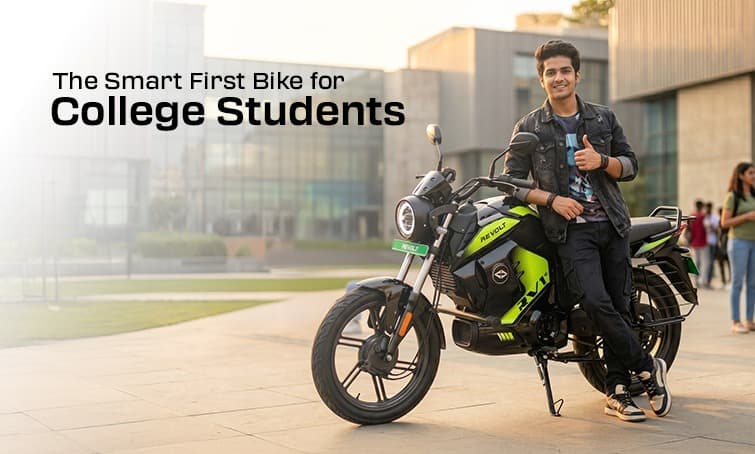
Getting your first bike as a college student in India is a big decision. It has to be affordable upfront, cheap to run every month, easy to handle for a new rider, and reliable enough that it does not become a problem to manage alongside studies. That is a lot to ask from one machine.
The Revolt RV1+ has been marketed at exactly this audience. But is it actually the right choice, or is it just good positioning? This blog breaks everything down honestly — cost, safety, practical limitations, and who this bike is genuinely suited for.
What Is the Revolt RV1+?
The RV1+ is the upgraded variant of Revolt's most affordable electric motorcycle, the RV1. It sits at the entry point of the Revolt lineup and is designed specifically for urban commuting — college runs & daily short-distance travel.
Quick Specs
| Features | Revolt RV1+ |
| Motor | 2.8 KW |
| Battery | 3.24 Kwh |
| Range | 160 Km/Charge* |
| Top Speed | 70 Kmph |
| Fast Charging | 80 Min |
| Kerb Weight | 106 Kgs |
| Payload Capacity | 190 Kgs |
| Price | ₹ 1,04,990 |
The Cost Question — What Does It Actually Cost a Student?
This is the most important section. Let us look at every rupee involved.
Upfront Cost
The RV1+ starts at ₹ 1,04,990 ex-showroom. On-road cost will vary by city once you add registration charges, insurance, and handling fees.
If your state has an EV subsidy, that comes off the ex-showroom price at the dealer. Several states including Delhi, Maharashtra, Gujarat, and Rajasthan offer subsidies ranging from ₹10,000 to ₹25,000 on electric two-wheelers. Check your state EV portal or ask your nearest Revolt dealership for the exact figure in your city.
Monthly Running Cost — The Number That Changes Everything
This is where the RV1+ changes the conversation entirely.
RV1+ Electricity Cost: A full charge costs approximately ₹25 to ₹35 depending on your city's electricity rate. At 160 km of range per charge, that works out to roughly ₹0.20 to ₹0.22 per km.
Petrol Bike Running Cost: A 110cc petrol bike delivering 65 km/l with petrol at ₹100/litre costs approximately ₹1.54 per km.
Monthly Comparison: 30 km Daily Commute, 26 riding days/month = 780 km/month
| Expense | Revolt RV1+ | Petrol 110cc Bike |
| Fuel/Electricity | ₹ 172 |
₹ 1200 |
| Monthly Maintenance | ₹ 100 |
₹ 500 |
| Monthly Running Cost | ₹ 272 |
₹ 1700 |
| Annual Saving with RV1+ | ₹ 17,136 |
- |
For a student on a tight monthly budget, saving ₹1,400+ per month is not a small number. Over two years of college, that is over ₹34,000 back in your pocket.
Maintenance Cost
The RV1+ has no engine oil, no spark plugs, no clutch plates, and no gearbox. The main maintenance items are:
- Tyre rotation and replacement (same as any bike)
- Chain lubrication and tension check (periodic, low cost)
- Brake pad inspection (once or twice a year)
- Annual service: approximately ₹1,000 to ₹1,500 at an authorised centre
A comparable petrol 125cc bike typically costs ₹4,000 to ₹6,000 per year in maintenance including oil changes, filter replacements, and servicing.
Charging at a Hostel or PG — The Real-World Question
Most students asking about this bike live in hostels, PGs, or rented rooms. Here is what you actually need to know:
The RV1+ battery is removable. You detach it from the bike, carry it to your room like a laptop, and plug it into a standard 3-pin 15A socket. No charging point in the parking lot needed.
The battery weighs approximately 12 to 14 kg — manageable to carry up a flight of stairs, though not effortless. If your hostel has a lift, this is a non-issue.
One overnight charge (plugging in before bed) delivers a full battery by morning. For a 30 km daily commute, you would only need to charge every 4 to 5 days.
Safety — Is the RV1+ Safe for a First-Time Rider?
Safety is where this bike has a genuinely strong story. Let us go through it feature by feature.
1. Combined Braking System (CBS)
The RV1+ has disc brakes on both front and rear wheels with a Combined Braking System. When you apply the rear brake, CBS automatically engages the front brake as well, distributing braking force across both wheels. This significantly reduces the risk of the front wheel locking up during emergency stops — a common cause of falls for inexperienced riders.
For a first-time rider who does not yet have the instinct to balance front and rear braking correctly, CBS is a meaningful safety net.
2. 70 km/h Top Speed — Safer for Beginners
The RV1+ is capped at 70 km/h. This might seem like a limitation, but for a new rider on city roads, it is actually a feature. You cannot accidentally hit highway speeds you are not ready for. The speed ceiling keeps you in a range where you can react safely to traffic, potholes, and sudden stops.
For comparison, a 150cc petrol bike can reach 100 to 120 km/h — a range where mistakes for new riders become far more serious.
3. Low Seat Height and Light Weight
The RV1+ has a seat height of 790 mm and a kerb weight of 110 kg. Most college-age riders — male or female — can plant both feet flat on the ground at a traffic light. At 110 kg, the bike is light enough to handle easily in parking situations, U-turns, and low-speed manoeuvres.
Compare this to a 150cc petrol bike which typically weighs 140 to 155 kg.
4. No Gears — Zero Clutch Anxiety
The RV1+ has no manual gearbox. There is no clutch lever, no gear shifting, no stalling at intersections. You twist the throttle and go. For someone who has just passed their two-wheeler licence test, removing the cognitive load of managing gears makes city riding significantly more manageable and reduces one major source of beginner errors.
5. Eco Mode for Learning
The RV1+ has Eco and Sport riding modes. Eco mode softens throttle response and limits power delivery, making the bike gentler and more forgiving. New riders are strongly advised to start and stay in Eco mode for the first few months until throttle control becomes second nature.
6. IP67-Rated Battery — Safe in Rain
The battery carries an IP67 waterproof rating, meaning it is protected against dust ingress and temporary immersion in water up to 1 metre. You can ride through monsoon puddles and wet roads without worrying about electrical damage or shorts. This is particularly relevant for students in cities like Mumbai, Kochi, or Chennai where monsoon season is severe.
7. LED Lighting All Around
Full LED headlamp, tail lamp, and LED turn signals come standard. In low-visibility conditions — evening rides, foggy winter mornings, dimly lit college lanes — the brightness difference between LED and halogen lighting matters for how early other road users see you.
Who Is This Bike Actually Right For?
The RV1+ is an excellent first bike if:
- Your daily commute is 20 to 40 km
- You study in a city where Revolt has dealership presence
- You can charge the removable battery at home, hostel or PG
- You want to minimise monthly running costs — especially important on a student budget
- You are a new rider who wants a no-gears, manageable motorcycle to build confidence
You should look at other options if:
- You are in a city with no Revolt dealer (service will be a problem)
- You regularly need to travel intercity distances of 150 km or more
- You need real-time GPS tracking and geo-fencing for security
- Your college parking is extremely tight and charging access is zero
The Honest Verdict
The Revolt RV1+ is one of the most financially sensible first bikes available in India in 2026 for a student with a daily city commute. The monthly running cost advantage over a petrol bike is real and significant. The safety features — CBS braking, 70 km/h cap, no gears, low seat height — are genuinely beginner-friendly. The removable battery solves the charging problem for hostel and PG dwellers elegantly.
Ready to experience the RV1+ before deciding? Book a free test ride at your nearest Revolt Hub — it takes 10 minutes and will tell you more than any blog can.