

Government Policies Supporting Electric 2 Wheelers: What You Need to Know
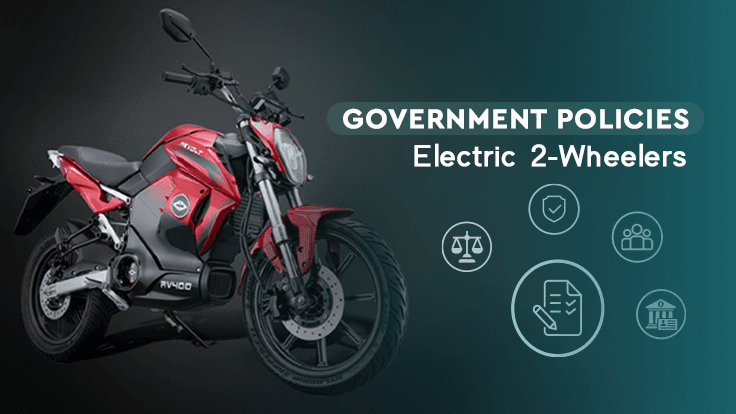
The Indian government has been heavily advocating the shift to electric two-wheelers, which is now picking up steam. The rising cost of fuel, electricity, and pollution, alongside the urgent need for eco-friendly modes of transportation, have rendered electric mobility imperative. To fast-track this transition, the Indian government has enacted multiple policies and provides subsidies, tax incentives, and infrastructure development plans.
Union Minister for Road Transport and Highways, Nitin Gadkari, has projected that electric vehicles (EVs) will achieve cost parity with petrol and diesel vehicles. Nitin Gadkari ji, (Minister of Road Transport and Highways of India) recently stated in an interview his goal to replace all petrol-powered two-wheelers with electric ones by 2026.
If you want an electric two-wheeler, these policies can help you make a budget-friendly purchase. Now, let's explain the core government policies and their impact on the future of electric mobility in India.
FAME Scheme: Driving the EV Revolution
What is the FAME Scheme?
The FAME scheme, which stands for "Faster Adoption and Manufacturing of Electric Vehicles", is an initiative to reduce carbon footprint as much as possible. This program targets the quality demand creation, technology development, pilot projects and charging infrastructure expansion that includes:
- Demand Creation: Provides incentives and encourages consumers to purchase electric vehicles.
- Technology Development: Funds innovation in battery technology and Electric Vehicle components.
- Pilot Projects: Implements solutions to test electric mobility in real-life conditions.
FAME I vs. FAME II
FAME II introduced a $1.4 billion budget in 2019 and improved FAME I's financial aid for electric vehicles, which was too limited in scope.
| Feature | FAME I (2015-2019) | FAME II (2019-Present) |
|---|---|---|
| Budget | $130 million | $1.4 billion |
| Target Vehicles | 280,000 | 1.5 million (including 10 million electric two-wheelers) |
| Subsidy for E-Bikes | $140 per unit | $280 per unit |
| Charging Stations | Limited expansion | 2,636 charging stations planned |
Recent Revisions to FAME II
FAME II launched with a three-year budget of ₹10,000 crore starting April 1, 2019. In June 2023, the Ministry of Heavy Industries revised the FAME II subsidy to ₹10,000 per kWh, down from the earlier ₹15,000 per kWh, with the cap on incentives for electric two-wheelers reduced to 15% of the ex-factory price from the previous 40%. FAME 2 concluded on March 31, 2024.
Electric Mobility Promotion Scheme (EMPS)
The Electric Mobility Promotion Scheme (EMPS) 2024 commenced on April 1, 2024, with an initial budget of Rs. 500 crore, running until July 31, 2024. Further reductions occurred in March 2024 under the Electric Mobility Promotion Scheme (EMPS), lowering subsidies to ₹5,000 per kWh, capped at ₹10,000 per two-wheeler. EMPS was extended for an additional two months, making the new end date September 30, 2024.
PM E-DRIVE Scheme
The government disclosed the official notification of the PM E-DRIVE scheme on 29 September 2024. The starting date of the PM E-DRIVE scheme is 1 October 2024 and will be effective till 31 March 2026. This scheme offers a demand incentive of ₹2,500 per kWh and would provide demand incentive worth ₹3,679 for electric two-wheelers, three-wheelers (including e-rickshaws), and other commercial electric vehicles registered from April 1, 2025.
Eligibility Criteria for FAME II Subsidies
Not all electric two-wheelers qualify for these subsidies. To be eligible, vehicles must meet specific criteria, including:
- : Range and Speed - A minimum range of 80 km on a single charge and a top speed of at least 40 km/h.
- : Localization - At least 50% of the components must be sourced locally to promote the 'Make in India' initiative.
- : Battery Type - Utilization of advanced battery technologies, such as lithium-ion battery.
- : Regulatory Compliance - Vehicles must be registered under the Central Motor Vehicle Rules (CMVR), 1989.
Revolt Motors checks all the boxes. With models like the RV400, Revolt ensures compliance through locally sourced components, advanced lithium-ion batteries, and convenient charging solutions that fit into everyday life.
PLI Scheme: Boosting Local EV Manufacturing
To position India as a leader in EV production, the government implemented a new scheme in 2021 called Production Linked Incentive (PLI). This program compensates electric two-wheeler manufacturers, as well as battery and components.
Key Highlights of the PLI Scheme
- : Budget Allocation - $3.4 billion for EVs and auto parts production.
- : Implementation Period - 2022-2028.
- : Incentive Provision - 18% of revenue from qualifying sales of EVs and components.
Moreover, the PLI scheme sets aside $2.4 billion for the Advanced Chemistry Cell (ACC) battery production. This will aid in decreasing the cost of the battery making electric bikes more economically feasible in India.
Battery Swapping and Safety Regulations
Safety and convenience go hand in hand with battery technology, which is a critical factor for the success of electric two-wheeler vehicles. For such goals, the government has proposed:
The Electric Edge: A New Kind of Performance
- Battery Swapping Policy (2022) - Sets a national adoption program for standardized batteries that can be swapped instantly to reduce charging times.
- Fast Charging Infrastructure - Efforts are underway to expand the public EV charging network, including the deployment of both slow and fast chargers. Global examples like the potential of high-speed charging-with claims of up to 470 km range added in just 15 minutes, placing it ahead of even Tesla's Supercharger capabilities.
- Removable Battery - Electric bikes with removable batteries, like those from Revolt, offer users the convenience of charging batteries separately, addressing challenges related to charging infrastructure.
These policy measures were created to motivate companies to improve their EV battery technology and strive to make the top electric bikes in India safer and more effective.
How These Policies Impact the Market
Incentives from the government have completely redesigned the market for electric bikes in India. The changes are evident in the sales growth over the years:
| Year | Electric Two-Wheelers Sold | Growth Rate |
|---|---|---|
| 2015 | 12,000 | - |
| 2021 | 153,000 | 128% (YoY) |
| 2022 | 327,900 | 115% (YoY) |
| 2023 | 846,976 | 158.3% (YoY) |
India has surpassed the sales of 1.3 million electric two-wheelers sold in the first half of 2023, catapulting India to second in the world after China for the most electric scooters sold. The government also hopes that by 2030, 80% of two-wheelers and three-wheelers sold will be electric. One name that's accelerating this shift is the Revolt RV400. Let's look at the RV400 features below.
Revolt RV400 - A Game-Changer in the EV Space
The Revolt RV400 is one of the top electric bikes in India because of its technology and how it outperforms other electric bikes in its class. It is a model built to replace petrol bikes with a more affordable and efficient option.
Revolt RV400 Specifications
| Feature | Revolt RV400 |
|---|---|
| Battery Type | Lithium-Ion |
| Battery Capacity | 3.24 kWh |
| Charging Time | 0-80% in 3h 30m (Normal) / 1h 20m (Fast) |
| Top Speed | 85 km/h |
| Range | 150 km (Eco Mode) / 100 km (Normal Mode) / 80 km (Sports Mode) |
| Brakes | Front & Rear Disc (240mm) |
| Weight | 115 kg |
| Seat Height | 815mm |
| Ground Clearance | 200mm |
The RV400's app geofencing, sound, and remote start features are extremely cool. Riders can pick from four different engine sounds or mute the sound completely. And to top it off, it's backed by a reliable 3-year or 40,000-kilometer warranty, whichever occurs first ensuring both excitement and peace of mind on every ride.
Final Thoughts
India's efforts towards electric two-wheelers for the last few years made owning an EV less daunting and more appealing. FAME and PLI have increased production rates, lowered prices, and made charging stations more available, which has helped greatly.
The reduction of subsidies has caused certain electric bikes in India to get more expensive, but other factors like maintenance and fuel costs in the long-term make these bikes a good deal. With more government aid, India can soon become one of the leaders in electric vehicles, which is great for the region.
This invitation is open to anyone looking to switch to an electric two-wheeler. These policies make adopting cleaner vehicles easier, so leap while you can. Check out Revolt Motors and book your RV400 electric bike now!