

How Electric Bike Charging Infrastructure Is Expanding in India
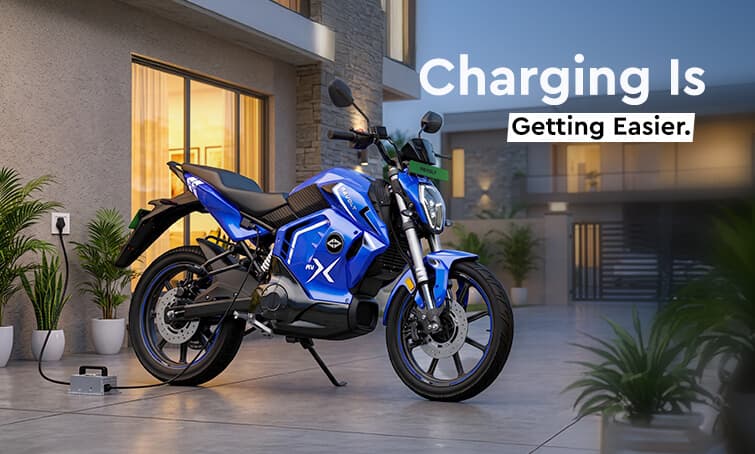
Charging infrastructure is one of the most-asked-about, and least well-understood, parts of owning an electric motorcycle in India. The short version: home charging still covers the vast majority of actual usage, but public infrastructure has expanded meaningfully over the last couple of years and is starting to matter for longer trips, so it's worth understanding both sides of the picture before you buy. Most electric bike owners in India charge overnight at home using the standard charger that comes with the bike, plugged into a regular household socket. It's slower than a dedicated fast charger, but for a bike parked overnight anyway, speed doesn't matter as much as reliability and convenience. Our guide to electric bike charging time explained covers what actually affects how long a full charge takes, from battery capacity to ambient temperature. For riders without a dedicated outlet near their parking spot, removable battery packs sidestep the infrastructure question entirely, you carry the battery to wherever the outlet is, rather than needing a charging point built into your parking. Our detailed look at RV1+ charging time and running costs walks through this approach specifically, including realistic charging windows for a typical overnight or workday charge. Public EV charging points, primarily built out for cars and to a lesser extent scooters, are expanding across major metros and highway corridors, though coverage is still concentrated in tier-1 and tier-2 cities. For most day-to-day motorcycle commuting, this matters less than home charging access, but it's increasingly relevant for longer intercity trips where topping up mid-journey becomes useful. Highway-adjacent charging points in particular have grown as more EV four-wheelers create demand for that infrastructure, and two-wheeler riders benefit from the same build-out indirectly. Metro cities like Delhi, Bengaluru, and Mumbai have seen the fastest growth in public charging density, driven partly by state EV policy incentives and partly by sheer EV adoption volume creating commercial demand for charge point operators. Tier-2 cities are catching up but remain noticeably thinner, while smaller towns still rely almost entirely on home and workplace charging. This uneven build-out is worth factoring into expectations if you're relocating or if your commute regularly crosses between city tiers. Several states have introduced EV-specific policies that include charging infrastructure incentives alongside vehicle subsidies. Delhi's revised EV policy is a notable example, our coverage of Delhi EV Policy 2.0 details what it changes for both buyers and charging infrastructure in the city specifically, and similar policy patterns are gradually appearing in other states as well. Between home charging and public infrastructure, a third option has been gaining ground: charging points installed by employers or residential societies specifically for resident or employee EV owners. This isn't as widespread as home charging yet, but it's a meaningful option for commuters who lack a dedicated outlet at home but have consistent daily access to a workplace or society parking area with charging support. Worth asking your employer or society management directly if this is something they've considered or already installed. Given the pace of public charging investment tied to four-wheeler EV growth, and continuing state-level policy support, expect public infrastructure density to keep improving steadily over the next couple of years, particularly along major highway corridors and within metro cities. For two-wheeler owners specifically, this build-out is a genuine bonus for longer trips even though it isn't yet, and likely won't become, a substitute for reliable home charging as the everyday default. Don't assume you'll need to rely on public charging for everyday use, home charging remains the realistic default for most owners, and any model you're considering should work comfortably on that basis alone. Public infrastructure growth is a bonus for longer trips, not yet a substitute for reliable home or workplace charging access. Check with your nearest Revolt dealer about local charging support and setup guidance when you buy.Home Charging Is Still the Backbone
Removable Batteries Solve the Access Problem Differently
Public Charging Networks Are Growing, Unevenly
How Charging Point Density Differs by City Tier
State Policy Is Accelerating the Build-Out
Workplace and Society Charging Is a Growing Middle Ground
What the Next Few Years Likely Look Like
What This Means for Your Buying Decision Today