

PM Urges the Country to Save Fuel. Here's How You Can Contribute to the Movement!
On May 10, 2026, Prime Minister Narendra Modi stood before the nation in Hyderabad and said something that stopped people mid-scroll.
He asked every Indian not the government, not industry to personally save fuel.
He called it patriotism.
"Patriotism is not just about dying for the country. Living for the country and fulfilling our duties to the country is also patriotism. — PM Narendra Modi, May 10, 2026"
This was not a budget speech. Not a policy announcement. It was a direct, personal appeal from the Prime Minister to every citizen to consume less, waste less, and think about the nation when making everyday choices.
So what is actually going on? And what can you one person, one commuter, one two-wheeler rider actually do about it?
Why Is India in This Situation?
The short version: global crude oil prices have surged from around $70 per barrel to approximately $126 per barrel following escalating tensions in West Asia and disruptions around the Strait of Hormuz a narrow channel through which about 20 per cent of the world's energy supply passes.
India is deeply exposed to this.
India imports nearly 85% of its fuel needs and relies on the Strait of Hormuz for about 50% of its crude imports, 60% of its liquefied natural gas, and almost all of its liquefied petroleum gas supplies.
India spent $174.9 billion on crude and petroleum products, or 22% of its total imports in the financial year ended March 2026.
Every time oil prices rise, that number goes up. Every rupee India spends importing fuel is a rupee that leaves the country and right now, those rupees are leaving faster than ever.
This is why Modi did not just address policymakers. He addressed you. Because the solution is not just government policy it is millions of individual choices, made every single day.
What Modi Specifically Asked For
Modi urged people to adopt fuel conservation measures, revive work-from-home practices and reduce non-essential imports amid a sharp rise in global crude oil prices.
He suggested increased use of car-pooling and greater reliance on metro rail services in cities where such transport is available. He also encouraged continued adoption of electric vehicles to reduce dependence on fossil fuels.
The list included carpooling, working from home where possible, using public transport, and switching to electric vehicles.
For most Indians, the first three are limited by circumstances not everyone can work from home, not every city has a metro. But one of them is entirely in your hands, starting today.
The One Thing You Can Control: How You Fuel Your Daily Commute
India has approximately 200 million two-wheelers on its roads. Most of them run on petrol. Most of them are used for daily commutes of 20 to 40 km.
Each one visits a petrol pump roughly once or twice a week. Each one sends money overseas every single time.
Now imagine flipping that. One two-wheeler, running on electricity instead of petrol. The electricity comes from India's own grid coal, solar, hydro, wind. Produced here. Priced here. Staying here.
That is not a sacrifice. That is not an inconvenience. That is the most direct, practical response to exactly what Modi asked for.
The Numbers That Make This Personal
Let us make it real.
A typical Indian petrol two-wheeler rider covering 30 km a day spends approximately:
- ₹1,300 per month on fuel at current prices
- ₹15,600 per year on petrol
- ₹78,000 over 5 years — most of which contributes to India's import bill
Switch to a Revolt electric bike. Same commute. Same distance. Your bill becomes:
- ₹175 per month on electricity
- ₹2,100 per year
- ₹10,500 over 5 years
You save over ₹67,000 in 5 years. And India saves that foreign exchange.
At an individual level, that is a life-changing saving. At scale — if even 10 million two-wheeler riders made this switch — it is a measurable reduction in India's oil import bill.
This is what it looks like when individual action and national interest point in exactly the same direction.
India Is Already Moving Are You?
The response to Modi's appeal has been immediate and widespread.
Within days, government bodies in Modi's own constituency in Varanasi observed a No Fuel Day. Corporate leaders urged employees to reduce travel and switch to EVs. State governments accelerated EV infrastructure plans.
India's electric two-wheeler segment has been growing rapidly record sales of approximately 1.28 million units in 2025, growing at 11 per cent year on year. The market is moving. The infrastructure is expanding. The government is subsidising the switch.
The PM E-DRIVE Scheme: India's central EV subsidy programme is currently active, reducing the purchase price of qualifying electric two-wheelers at the point of sale. Several states stack additional subsidies on top. In some cities, the combined saving from central and state subsidies brings the effective price of an electric bike to within ₹10,000 to ₹15,000 of an equivalent petrol bike.
The window for maximum support is open right now. It will not stay open forever.
What You Can Do Today
You do not need to make a grand gesture. You do not need to change your whole life.
Here is what contributes directly to the movement Modi described:
If you are planning to buy a bike: Make your next one electric. The financial case is already stronger than petrol. The national case now is too.
If you already own a petrol bike: Start calculating your annual fuel spend. Compare it to an electric bike's running cost. The break-even point on switching is typically under 2.5 years and every petrol price hike that follows shortens it further.
If you are not ready to switch yet: Carpool when you can. Use public transport for one trip a week. These are small choices but Modi's appeal was precisely about small choices made by millions of people, not big gestures made by a few.
Why an Electric Bike Is the Easiest Entry Point
An electric car costs ₹10 to ₹15 lakh. It requires a dedicated charging setup. It is a major decision.
An electric bike? It starts under ₹99,000. It has a removable battery you charge from any 3-pin socket at home — overnight, exactly like your phone. It saves you over ₹3,000 every month from day one. And it answers the Prime Minister's call in the most direct, practical, personally rewarding way available to a two-wheeler commuter.
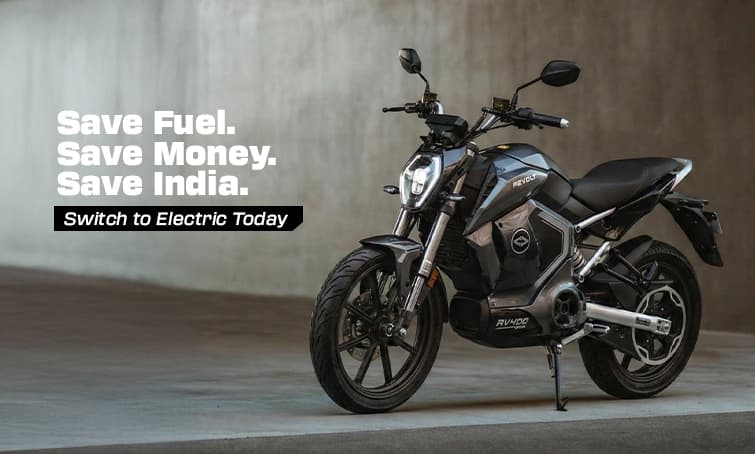
The Revolt lineup — RV1, RV1+, RV BlazeX, RV400 — covers every budget and riding need from under ₹99,999 to ₹1.5 lakh. All come with removable batteries. All are eligible for central and state subsidies. All are available for a free test ride at Revolt Hubs across India.
The Bottom Line
India is facing a real energy challenge. The Prime Minister has asked every citizen to be part of the solution.
For two-wheeler commuters, there is a response that is not a sacrifice — it is an upgrade. It costs less to run. It saves you money from month one. It reduces what India sends abroad for fuel. And it is available to book and test ride today.
Riding electric is not just a smarter personal choice anymore.
In May 2026, it is also an act of patriotism.
Book a free test ride at your nearest Revolt Hub and be part of India's fuel conservation movement one kilometre at a time.