

Electric Two Wheeler Price in India (2026): What You Get at Every Budget
Electric two-wheeler prices in India span an enormous range, from under ₹90,000 low-speed scooters to performance electric motorcycles well past ₹3 lakh. Rather than list every model, this guide breaks the market down by what you actually get at each budget tier, so you can figure out where your money genuinely goes.
Under ₹1 Lakh: Entry-Level Territory
At this price point, you're mostly looking at compact electric scooters and the most basic electric bike models. Expect smaller battery packs (often under 2.5 kWh), shorter real-world range (typically 50-80 km), and fewer smart features. Models like the TVS Orbiter, base variants of the Ola S1 X, and Revolt's entry motorcycle options fall in this range. This tier suits short, predictable commutes where maximum range and premium features aren't priorities — a genuinely sensible starting point for a first-time EV buyer on a tight budget.
₹1 Lakh to ₹1.5 Lakh: The Sweet Spot for Most Buyers
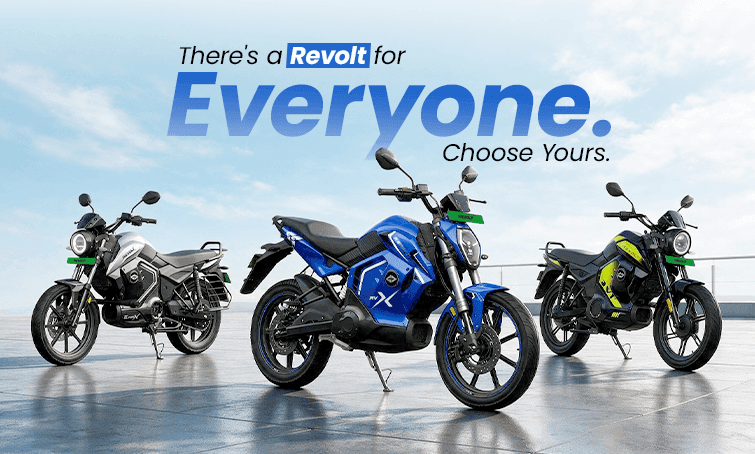
This is where the market gets genuinely competitive, and where most mainstream electric bikes in India are positioned. In this range you'll typically find larger battery packs (around 3–3.5 kWh), IDC-claimed ranges in the 120–160 km bracket, and a meaningful jump in connected features — app control, geo-fencing, OTA updates. The Revolt RVX sits at ₹1,29,990 ex-showroom in this exact bracket, alongside competitors like the Oben Rorr Evo (~₹1.25 lakh) and Ola Roadster X variants. This tier represents the point where an electric motorcycle genuinely starts to feel like a complete, feature-rich product rather than a stripped-down commuter.
₹1.5 Lakh to ₹2 Lakh: Stepping Into Performance
Models in this bracket start prioritizing performance specs more explicitly — quicker 0-40 acceleration, higher top speeds, and in some cases larger battery packs pushing range past 180 km. The Ultraviolette X-47 (~₹2.49 lakh, technically just above this bracket) and higher variants of several brands' flagship commuter-performance hybrids sit around here.
₹2 Lakh and Above: Premium and Performance-First
At the top end, you're paying for genuine performance credentials — the Ultraviolette F77 (~₹3.09 lakh) is the clearest example, competing more directly with performance petrol motorcycles than with typical commuter EVs. Range, top speed, and acceleration all scale up significantly, but so does the price gap versus the mainstream ₹1-1.5 lakh segment.
What Actually Drives the Price Difference
It's worth understanding what you're paying for as price increases, since it isn't just "more range":
Battery capacity and chemistry — larger packs cost more, and premium chemistries (like certain LFP formulations) can carry a cost premium over standard options
Motor power and peak output — higher kW ratings generally mean stronger acceleration and higher top speeds, at a real cost
Connected features — app integration, geo-fencing, voice commands, and OTA update infrastructure all add engineering and software cost
Build materials and suspension — upside-down forks, monoshock rear suspension, and premium panel materials show up more consistently as price increases
Brand service network — a wider physical service network, which matters enormously for long-term ownership confidence, is itself a cost center reflected in pricing
Comparing Total Cost of Ownership, Not Just Purchase Price
Sticker price is only part of the real cost comparison across budget tiers. A cheaper bike with a smaller battery may cost less upfront but deliver a shorter range, meaning more frequent charging and, for some riders, a genuine limitation on longer trips. A pricier bike with a stronger battery warranty can mean meaningfully lower long-term risk of an expensive out-of-warranty battery replacement. When comparing tiers, it's worth mentally adding a rough estimate of servicing costs, insurance, and battery replacement risk to the sticker price, rather than comparing ex-showroom figures in isolation.
How Financing Changes the Picture Across Tiers
Most buyers in every price tier now finance their purchase through an EMI plan rather than paying the full amount upfront. This changes how "expensive" a given tier actually feels month to month, a ₹1.5 lakh bike financed over three years can have a lower monthly commitment than a ₹1 lakh bike financed over one year, depending on the down payment and interest rate involved. When budgeting, it's worth comparing likely monthly EMI figures across tiers rather than purely comparing ex-showroom prices, since the tier that looks more expensive on paper may not be the tier that's actually harder to afford month to month.
Don't Forget: Subsidies Change the Real Number
Every price mentioned above is the ex-showroom figure before subsidies. Depending on your state, government incentives can reduce your effective price by anywhere from ₹5,000 to ₹40,000 or more when combining central and state benefits. Always ask your dealership for the post-subsidy price, not just the listed ex-showroom figure — the gap between the two can meaningfully shift which budget tier a bike actually falls into for you personally.
A Practical Way to Choose Your Budget
Rather than picking a price tier first, work backward from your actual daily distance and how much of a "feature" bike you want versus a purely functional commuter. A rider covering 30-40 km daily with no interest in app connectivity is genuinely well served by a sub-₹1 lakh option. A rider who wants their bike to double as a lifestyle statement, with real performance and smart features, is better served in the ₹1-1.5 lakh bracket — which is also where you'll find the strongest combination of value and capability across most brands right now.
Where to Go From Here
Compare Revolt models directly to see exactly what you get at each price point in our own lineup, or book a test ride to feel the difference in person.
Conditions apply. Figures marked with an asterisk are claimed/rated values based on internal testing under standard conditions. Actual performance may vary depending on riding conditions, road and terrain, load, tyre pressure, rider weight, and riding style.