

How Summer Heat Affects Your Revolt Electric Bike's Battery: What to Do Differently in 45°C Indian Summers
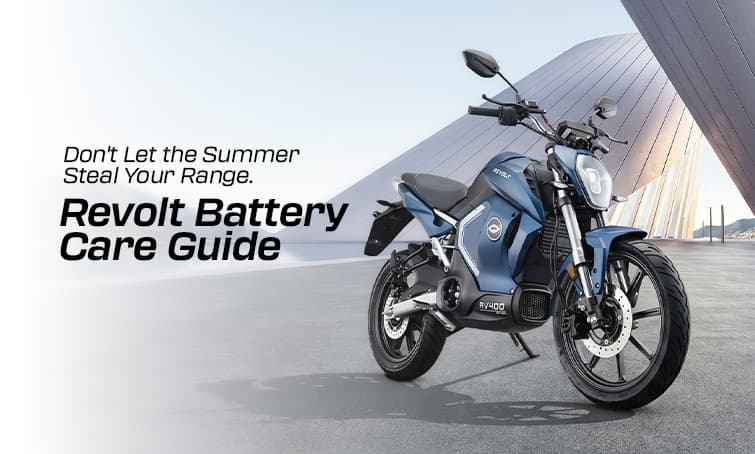
You already know Indian summers are no joke. Delhi, Rajasthan, UP, Nagpur from April to June, temperatures regularly hit 44°C to 48°C. Your skin feels it. Your water bottle feels it. And your Revolt electric bike's battery feels it too.
The Good News: your Revolt bike is built for India. It can handle the heat. But like most things in life, it handles the heat better when you give it a little extra care during these three months.
This guide skips the complicated science and gives you simple, practical answers to one question: what should you do differently with your Revolt in summer?
First Why Does Heat Even Affect Your Battery?
Here is a simple way to think about it.
Your phone battery drains faster in summer, right? Same idea. Heat makes batteries work harder than they need to, which wears them out faster over time.
Your Revolt battery is much bigger and better protected than a phone battery but the same basic rule applies. When it gets very hot, two things happen:
Right Now: Your range drops a little. A bike that gives you 120 km in February might give you 100 to 105 km in May. That is completely normal not a sign anything is broken.
Over Time: If the battery sits in extreme heat repeatedly especially while fully charged it ages faster than it should. This means less range over the years than you paid for.
The simple goal of everything in this guide is to avoid that second problem.
Quick Fact: Parking your dark-coloured Revolt in direct afternoon sun in Delhi can push the battery temperature to 52–56°C even on a 44°C day. That is the range where things start to wear faster.
Your Revolt Is Already Protecting Itself Here Is How
Before we get to what you should do, here is the reassuring part: your bike is already doing a lot on its own.
Every Revolt model RV1+, RV BlazeX, and RV400 BRZ — has a smart system inside called a Battery Management System, or BMS. You do not see it or interact with it. It just quietly runs in the background.
Think of the BMS as a caretaker for your battery. It watches the temperature, charge level, and power going in and out — constantly. When things get too hot during a long ride, it automatically reduces the bike's power slightly to bring the temperature down. You might notice a tiny drop in acceleration on a long summer highway run — that is the BMS doing its job, not something going wrong.
Your battery also carries an IP67 rating, which means it is sealed against dust and water. That thick, weatherproof casing also helps insulate it from the worst of the heat.
So your bike has a safety net. But — and this is important — the safety net is for emergencies, not for everyday habits. The BMS is like the circuit breaker in your home. Useful when something goes wrong. But not a reason to leave everything plugged in at full load, every day, in the middle of summer.
Your habits matter too. Here is what to change.
7 Simple Things to Do Differently This Summer
1. Wait Before You Charge After a Hot Ride
This is the biggest one. It makes the most difference.
When you get home after riding in 42°C heat, your battery is warm — from the hot air and from being used. If you plug it in immediately, you are charging a hot battery. That is harder on the battery than charging a cool one.
What to do instead: Park the bike, get inside, drink some water, relax for 20 to 30 minutes — then plug in. For longer rides (over 30 km) on a very hot day, wait 40 to 45 minutes.
If you have the removable battery (RV1, RV1+, RV BlazeX), an even better move is to take it inside into a cooler room before charging. Let it sit at room temperature for a bit, then plug in.
One thing not to do: do not put ice or cold water on the battery to "speed up" the cooling. Let it cool down naturally.
2. Charge to 80%, Not 100%, for Daily Use
Most of the year, charging to 100% overnight is perfectly fine. In summer, try to stop at 80% for your normal daily commute.
Why? A fully charged battery sitting in summer heat wears out faster. It is like keeping a pressure cooker at full pressure all day — technically fine, but harder on the equipment.
The practical reality: For a 20 to 40 km daily commute, 80% charge is more than enough. You will not even notice the difference.
Only charge to 100% when you have a long ride coming up — and do it the night before when it is cooler, not first thing in the morning.
3. Charge at Night, Not in the Afternoon
At 3 PM in Delhi, the temperature is 44°C. At midnight, it is 29°C. Same city, same day, 15 degrees difference.
Charging your battery in a cooler environment is simply easier on the cells. Late evening and night charging is ideal in Indian summers.
The worst time to charge? Right when you get home in the afternoon (say, 2 to 4 PM) after the battery has been sitting in the sun all day. That is hot battery + hot environment + charging heat all at once.
If you get home after work at 7 or 8 PM, that is fine — temperatures have started to drop by then. Or just plug in before you sleep. Either works.
4. Park in Shade Make It a Habit, Not an Afterthought
You probably already try to park in shade when you can. In summer, upgrade this from "nice to have" to "non-negotiable."
A black or dark-coloured Revolt parked in direct afternoon sun for 4 hours can reach surface temperatures of 55 to 65°C. The battery inside is soaking up that heat the whole time.
Practical options:
Best: Underground or covered parking — even a warm basement is far better than an open rooftop
Good: Under a tree, a building overhang, or any structure that blocks the afternoon sun (west-facing sun between 1 and 5 PM is the strongest)
Easy win: A silver or light-coloured bike cover can reduce the surface temperature by 8 to 12°C compared to leaving the bike uncovered
If you park at an office with no shade at all, try to position the bike so the battery side faces away from the afternoon sun.
5. Use Eco Mode More Often
Your Revolt has riding modes — Eco, Normal, and Sport. In summer, lean towards Eco for your everyday city rides.
Here is the simple reason: Sport mode makes the battery work harder, which makes it generate more heat. Eco mode is gentler, which keeps temperatures lower during the ride.
You do not need to stay in Eco mode all the time. Use Sport when you need to overtake or get through a tricky junction. But for 30 minutes of stop-and-go city traffic? Eco mode keeps your battery cooler and your range longer at the same time.
In summer, that is a double win.
6. Remove the Battery and Bring It Inside If the Bike Will Sit for 2+ Days
Going out of town for the weekend? Bike not being used for a few days?
Remove the battery and keep it indoors. A cool room at 25°C is a much better environment for your battery than a parking lot baking at 45°C for three days straight.
Store it at around 40 to 60% charge not fully charged, not empty. That middle range is the battery's comfort zone for resting.
This one tip alone can make a meaningful difference to your battery's long-term health if you live in a high-heat city like Jaipur, Ahmedabad, or Nagpur.
7. A Note on Range in Summer
You may notice your range is slightly lower in April and May compared to February. This is completely normal — not a defect, not a battery problem.
Heat naturally causes a 10 to 15% reduction in real-world range. So if your RV400 gives you 130 km in winter, expect around 110 to 115 km in peak summer.
Three easy ways to manage this:
Plan for slightly less range. Treat 85% of your usual range as your summer number.
Charge a little more often. Instead of one big overnight charge to 100%, try topping up to 60 or 70% more frequently. This is actually healthier for the battery.
Use Eco mode in the last stretch. If you are getting close to home with 15 to 20% battery on a hot day, switching to Eco mode for the final few kilometres is smart — not a sign of defeat.
8. The Summer Checklist — Save This
Before your ride:
- Check battery temperature in app (especially for long rides)
- Make sure the bike was parked in shade or covered overnight
While riding:
- Use Eco or Normal mode for city commuting
- Avoid long high-speed riding between 12 PM and 4 PM if possible
After your ride:
- Wait 20 to 45 minutes before plugging in
- Park in shade; put the cover on if no shade available
When charging:
- Charge at night or late evening
- Stop at 80% for daily use
- Charge indoors or in a shaded, ventilated spot
- If the bike sits unused for 2+ days:
- Remove battery and store it indoors at 40 to 60% charge
The Bottom Line
Your Revolt is made for India — the heat, the roads, the conditions. It will handle the summer just fine.
But giving it a little extra attention during April, May, and June makes a real difference over the long run. The habits above are not complicated. Most of them take zero extra time — it is just a matter of when you charge and where you park.
Do these things consistently through summer, and your battery will stay as healthy in year four as it was in year one.
Want to know how your battery is doing right now? Book a battery health check at your nearest Revolt Hub takes under 30 minutes and gives you a full picture of where your battery stands.