

RVX Torque Explained: Why Instant Power Changes How You Ride
Ask any rider who’s just switched from a petrol bike to an EV what surprised them most, and torque is almost always the answer. Not top speed. Not range. Torque — that immediate, no-warning-required pull the moment you twist the throttle. This piece isn’t a general explainer on what torque is (we’ve covered that broader ground in Instant Torque Explained) — this is a direct, numbers-first comparison of how the RVX’s torque actually stacks up against what you’re used to on a petrol bike, and against a genuine rival in its own price segment.
The RVX’s Numbers, Up Front
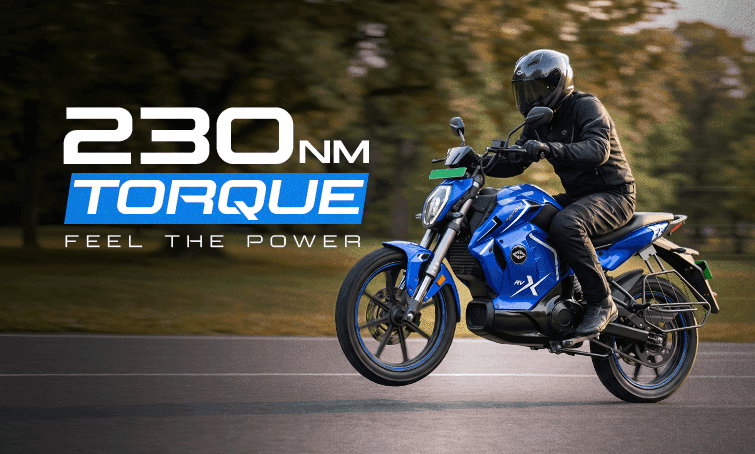
The RVX produces 50 Nm of motor torque and 230 Nm at the wheel, delivered instantly from a standstill — no RPM climb required. That last part is the whole story, and it’s where the real comparison begins.
RVX vs. a Typical 150cc Petrol Commuter
A typical 150cc petrol commuter motorcycle produces torque in a broadly comparable numeric range at the crank — but that torque only becomes usable after the engine builds RPM, and the rider works through gears to keep it in the power band. In practice, this means:
Petrol bike: twist the throttle, wait for revs to build, shift up as speed increases, torque peaks somewhere in the mid-range of each gear
RVX: twist the throttle, torque is already there, no gear changes needed to access it
This is why two bikes with similar torque numbers on paper can feel completely different in a real traffic gap. The RVX’s advantage isn’t that its number is dramatically higher — it’s that the number is available the instant you ask for it.
RVX vs. the Oben Rorr Evo: An Honest Look
The RVX sits in a genuinely competitive price segment, and it’s worth being straight forward about how it compares to the closest rival at a similar price point, the Oben Rorr Evo. The Rorr Evo’s claimed motor output is higher on paper, and its claimed 0-40 kmph acceleration is quicker than the RVX’s. This is a real, fair point of comparison — not every spec favours the RVX in this segment.
Where the RVX holds its own is in the overall balance of the package: fast charging that matches the Rorr Evo’s, a removable battery for flexible charging, and a broader set of connected and rider-assistance features layered on top of a genuinely strong torque figure. Buyers comparing the two shouldn’t rely on torque alone as the deciding factor — it’s one input among several, and this is exactly the kind of side-by-side worth doing before finalising a purchase in the electric bike price conversation.
What This Comparison Actually Means for Your Riding
Numbers are useful, but here’s what a strong torque figure — instantly delivered — means for your Monday morning commute, regardless of which competing bike you’re cross-shopping against:
Overtaking feels safer, not riskier. You spend less time next to a truck because you can close the gap and move past quickly.
Traffic signal starts feel effortless. You’re not gunning an engine and hoping it responds fast enough — the RVX just goes, the moment you ask it to.
Carrying a passenger doesn’t kill your confidence. The RVX’s gradability of 14 degrees* with one rider and 11.5 degrees* with two means the extra weight of a passenger doesn’t turn every flyover into a struggle.
Torque vs. Horsepower: Why One Matters More for City Riding
If you’ve ever compared spec sheets across different electric bikes in India, you’ve probably noticed motor power in kW gets top billing, while torque is often listed almost as an afterthought. This is backwards for how most Indian riders actually use their bikes.
Peak motor power matters most at sustained high speeds — the kind of riding that happens occasionally, on open highways. Torque matters at every single traffic signal, every merge, every overtake — which, for the average urban commuter, is most of the ride. The RVX’s 5.3 kW peak motor rating is a genuinely strong number for this segment, but it’s the torque figures working alongside it that define how the bike actually feels for 90% of your riding time, in any comparison you’re making.
How Torque Changes With Two-Up Riding
A detail that’s easy to overlook when comparing spec sheets: torque requirements change significantly when you’re carrying a passenger. This is where the RVX’s engineering shows real thoughtfulness — the bike’s gradability figures are specified separately for solo and two-rider scenarios (14 degrees* solo, 11.5 degrees* with a passenger), which tells you Revolt tested and tuned the torque delivery with real Indian riding patterns in mind, not just a single-rider lab scenario used for headline comparisons.
If you regularly ride with a friend, partner, or family member on the back, this is worth asking about specifically during your test ride — request to try the bike two-up on an incline, not just solo on flat ground, and if possible, do the same with any rival bike you’re comparing it against.
The Drivetrain Behind the Numbers
Torque figures only matter if the bike can actually deliver them to the road. The RVX uses an upgraded chain drive — a 13T front sprocket, 60T rear sprocket, and a 120-link chain — specifically engineered to transfer that torque efficiently to the rear wheel. This is part of why the RVX doesn’t just have competitive numbers on a spec sheet; the numbers translate into a genuinely usable feel the moment you ride it, whatever you’re cross-shopping it against.
Torque and Riding Modes
Not every ride needs maximum aggression, and how the RVX’s torque is delivered actually changes across modes — a detail worth understanding if you’re comparing riding character rather than just headline numbers. If you want the full breakdown of how each mode changes the bike’s personality, RVX ride modes explained covers exactly how torque delivery shifts across Eco, City, Sports, and Boost.
The Bottom Line
Torque comparisons only tell half the story if you stop at the numbers. What matters is how that torque translates into confidence at a signal, in an overtake, or on an incline — measured not just against a petrol bike you’re used to, but against genuine rivals like the Oben Rorr Evo that buyers in this segment are actually cross-shopping. The RVX holds its own in that conversation, even where it isn’t the outright numbers leader.