

Revolt RV1+ vs Petrol 110cc Commuter Bikes: Real Monthly Cost
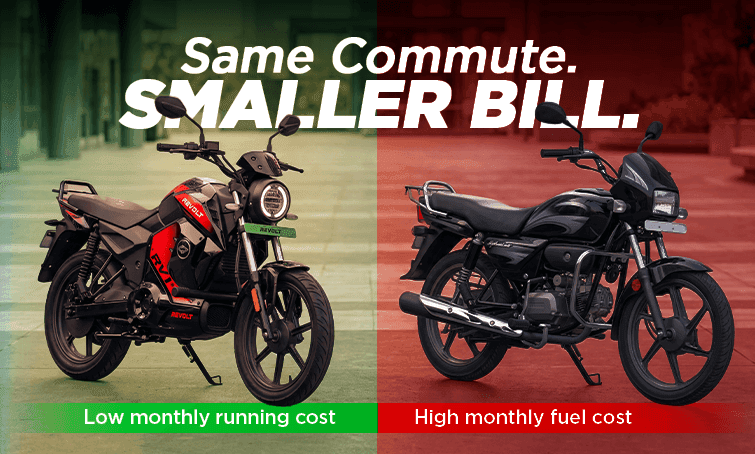
The two-wheeler you ride every day is one of your biggest recurring expenses, and most of that cost is not the bike itself. It is the fuel, the servicing and the small repairs that add up month after month. If you are comparing a daily-use commuter, you have probably asked the same question many riders ask: how much does a Revolt RV1+ really cost to run compared with a 110cc petrol bike?
This guide breaks down the monthly running cost of the Revolt RV1+ against a typical 110cc petrol commuter. We use clear assumptions, show the maths, and explain what changes the result so you can plug in your own numbers.
Revolt RV1+ at a Glance
The RV1+ is built for daily city commuting. Here are the key figures that matter for running cost.
*Claimed figures under test conditions. Real-world results vary with rider weight, load, speed, traffic and road conditions. Warranty terms apply. Check the latest details on the RV1+ page.
How We Calculate Fuel vs Electricity Cost
To keep this fair, we use conservative, round numbers. These are illustrations, not promises. Your actual cost depends on your local petrol price, your electricity tariff and how you ride.
Electric bike energy use: a full 3.24 kWh battery, plus roughly 10 to 15% charging loss, so about 3.6 kWh from the wall for a full charge.
Electricity price: ₹8 per kWh, a typical household figure. Many homes pay less on lower slabs and more on higher ones.
Real-world range: we assume 100 km per full charge, well below the 160 km* claimed IDC figure. This keeps the estimate on the cautious side.
Petrol bike: a 110cc commuter returning about 55 km per litre at ₹100 per litre.
With these inputs, a full charge costs about ₹29 (3.6 kWh x ₹8), which works out to around ₹0.30 per km. The petrol bike costs about ₹1.82 per km (₹100 divided by 55 km).
Monthly Running Cost: RV1+ vs 110cc Petrol
These numbers show the pattern clearly. The more you ride, the more you save, because the electric bike's cost per km is a fraction of petrol's. Revolt says its electric bikes can save up to ₹3,000 a month* depending on riding and local costs. Our conservative table is below that ceiling, which is a sensible way to plan. You can enter your own distance and local prices in the Electric Motorcycle Savings Calculator.
Servicing and Maintenance Costs
Fuel is only part of the story. A petrol bike has an engine that needs oil changes, filters, spark plugs, a clutch, a carburettor or fuel injection system and a chain that needs regular attention. Revolt's electric bikes do not need engine oil changes, filters, spark plugs, valves or carburettors, so there are fewer parts that wear out and fewer service items to pay for. That cuts the number of workshop visits and the surprise repair bills that come with an ageing engine.
Electric bikes still need care: tyres, brakes, the chain and general inspection are all part of ownership. Follow the service schedule in your owner's manual. For a broader look at the cost difference, see our guide on electric bikes vs petrol bikes.
The Battery: Warranty and Long-Term Cost
The biggest question most riders have about electric vehicles is battery life. The RV1+ battery carries a warranty of 8 years or 80,000 km, whichever comes first, and Revolt states the battery will be replaced if its health drops below 70% within the warranty period. The battery is also removable, so you can charge it indoors without needing a charging point near your parking space. Read more in our guide on RV1+ charging time and running cost.
Upfront Cost vs Running Cost
Electric commuters usually cost more to buy than a comparable petrol bike, and then save money every month. To understand the full picture, think of it as a break-even calculation: the monthly saving builds up until it covers the difference in upfront price. The faster you ride up the kilometres, the sooner you break even. Because on-road prices differ by city, check the current price on the official RV1+ page or at your nearest dealership, then divide the price difference by your monthly saving.
What Can Change the Result
Your daily distance: short, occasional trips save less than a regular commute.
Local petrol price: a higher petrol price makes the electric advantage larger.
Your electricity tariff: cheaper slabs or a solar-assisted home lowers the cost per km further.
Riding style and load: faster speeds and heavy loads reduce real-world range and raise energy use.
Incentives: central and state schemes change over time. Check current rules in your state before you buy. Our guide to government subsidy for electric bikes in India explains how to check.
Is the RV1+ Right for You?
The RV1+ makes the most sense if you commute daily within the city, ride at moderate speeds and want low running costs. Its 70 km/h* top speed suits urban roads, and the removable battery works well for people who park in shared spaces. If you want to compare it with other Revolt options first, read our detailed RV1+ review and the RV1 vs RV1+ comparison. To see the wider market, browse our top 10 electric bikes in India.
Final Verdict
On a conservative estimate, the Revolt RV1+ costs around ₹0.30 per km to run, compared with about ₹1.82 per km for a 110cc petrol bike. For a rider covering 1,000 km a month, that is a monthly saving of roughly ₹1,500 on fuel alone, before you count lower servicing costs. Your own figure will differ, so use your real distance and local prices to test it. When you are ready to feel the ride, book a test ride and see how the RV1+ fits your daily routine.